Sunday, 10 June 2012

Shwopping!

Looking at the Channel 4 closet swap reminded me of this campaign that Marks and Spencer launched a little while ago called shwopping.

The basic idea is that everytime you go in to buy a new piece of clothing you donate one at the same time.

M&S will then give this piece of clothing to Oxfam.

To launch the event, Marks and Spencer placed thousands of pieces of clothes all around the Truman Brewery and the area surrounding it in East London.

Here are some snaps of the event.


There is also a nice little introductory video on the website here:

http://social.marksandspencer.com/latest/joanna-lumley-and-ms-launch-shwopping/

And here is the TV advert:


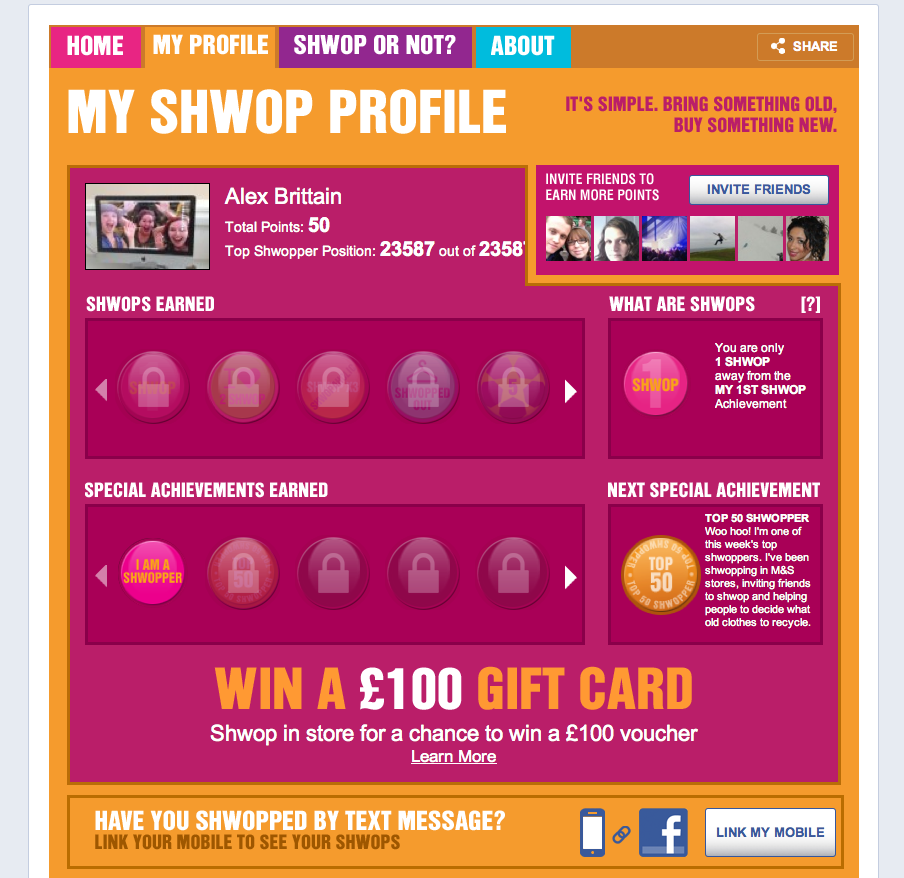
Like with the Closet Swap campaign, an important part is the interactivity; using the associated Facebook application, you can earn point and special awards, vote on other peoples clothes as to whether they should shwop or not and enter yourself into prize draws.

There are also leader boards - one for the person with the highest number of shwops and one for the store with the highest amount of clothes.

After you shwop you are given a code for your mobile phone which, like the closet swap, means the campaign is with you wherever you go.

Another thing I noticed form the campaign was the mentioning of the history and future of a product - something which I could think about with the products I have been looking into.




Article in the Guardian about the new campaign

http://www.guardian.co.uk/money/2012/apr/26/marks-spencer-shwopping-scheme

Channel 4 Closet Shop

Just came across a new interactive campaign Channel 4 are running called Closet Swap.

It's a campaign to raise awareness of sustainability within the clothing industry.

I noticed how the social side of the campaign was really important - being able to connect with your friends and view each others 'closets'. The fact they have an associated app is really clever - so you can take photos on the go and be connected with the campaign wherever you are.

I also really liked the map feature where users can see local sustainable or fair trade clothing outlets - this works so much better in the iphone app.

I thought the badge and point side of it was also interesting. As you use the website more, for example uploading your first photo, you gain points and earn badges for certain activities. This is a really interesting way of getting people to keep using the site - you want to earn more badges and gain points.

The ease of using this website is important - I found it a little confusing at first.

Lastly, I thought the fact they had a magazine connected to the campaign was really helpful as well as the fact they show designers who have some aspect of sustainability about them.

The vibrant colours give it a younger feel - maybe this is something I should think about depending on who I want to aim the campaign at.


Saturday, 26 May 2012

Obsolete Website Design

After designing some posters for the campaign I started designing the associated website.

I wanted to keep the design simple and clean and make the products the main focus of the website.

I decided to have a pages that:

 -introduce the idea of obsolescence and what the campaign is aiming to achieve

-a gallery that contains a wide range of obsolete items initially found by myself but then could be added to by the public. The objects would be broken down into categories based on their reason for being obsolete.

At the moment these are: restriction, superseded, component and accessory.

-an area that is a place for company and consumer to relate to one another. Perhaps providing helpful information on their products and help in fixing items.

Here is the website so far - if it's a bit small to see then here is a link to the website:

http://www.alexbrittain.com/100.swf
or
http://www.alexbrittain.com/200.swf for a bigger version.


Obsolete poster designs

So, after deciding I want to completely focus on the objects themselves, I've been thinking about how I can communicate this idea using the objects.

I have been thinking about designing a website and campaign that highlights the issue of obsolescence but creating a database of obsolete objects and their reasons for being in this state.

 I would also like the website to be a place where companies could promote the longevity of their products and could communicate with consumers directly. It seems that with some companies and specific products you have to go through a third party if you wish to fix the item yourself.

Although I understand that companies obviously want to make money and it raises the question what would be in it for them? Well, as I have found there are some companies such a Vitsoe and Huit that use the sustainibility factor to their advantage. Also, I think you have to remember that oil, which is found in thousands of everyday products, is a finite resource and as the years progress and amounts decline what is going to replace oil in plastics as the only alternative available currently is worse for the atmosphere.

I wrote a tagline for the website/campaign which would be:


To inspire the longevity of products; both on a consumer and company level.


I then started designing posters; each poster would focus on a particular object and why it could be seen as being obsolete.


British Plastics Federation

Found this article from the British Plastics Federation entitled:


“WHAT HAPPENS TO PLASTICS WHEN THE OIL RUNS OUT AND WHEN WILL IT RUN OUT?”


It is a really interesting article as it raises both the positive and negative points about oil in plastics but I found this quote to be most interesting:

“Is Substitiution of Plastics an Option?”


No -   In 2005 the GUA consultancy found that 40% of the life cycle energy cost of products is determined by the use phase: plastics are in general more energy efficient in the use phase than alternative materials.

  • Production of plastic products uses far less energy compared to traditional materials
  • Substitution of plastics by second best alternatives gives at 26% increase in energy consumption; and a 56% increase in global warming.


So, in fact at this point in time, there is no suitable alternative to plastics. Therefore it raises the question what will happen to all our products when oil run out?

Also, will people start to develop alternatives to plastics and is there enough time to find a better alternative before oil runs out?

Pentalobular screws on my iPhone

So after finding out about these pentalobular screws, I started having a look at my own Apple products.  I found that they didn't exist on my iPhone 3G, however they do on my iphone 4S.

Here are a couple of photos:


Thanks to the macro lens I was able to get a real close up shot of the screw head.

Finding this makes me wonder what other components in products are restricting our access to fix them or if there are specific components that are not as well made as they could be.

This got me thinking about the printers they discussed in the film 'Pymarids of Waste', where they claim that there is a piece that is designed to break after so many hours of use.

Would like to investigate this further.

Pentalobular Screws

Searching around apple products I found an article somebody wrote about Pentalobular screws on a gadget blog.

The author writes:

'They are new and rare.The screws require a special screwdriver rather than a standard Phillips-head jobby, making it harder to get hold of the kit required to crack open your iBlower.'


I then found this video from ifixit that explains to users these types of screws and how they can go about opening up their phone.


It just seems really strange to me how apple seems to be making it more difficult for people to fix their own products.
Perhaps it is because of safety issues, although it is probably more likely the fact they want to keep all repairs completeted within Apple grounds.